
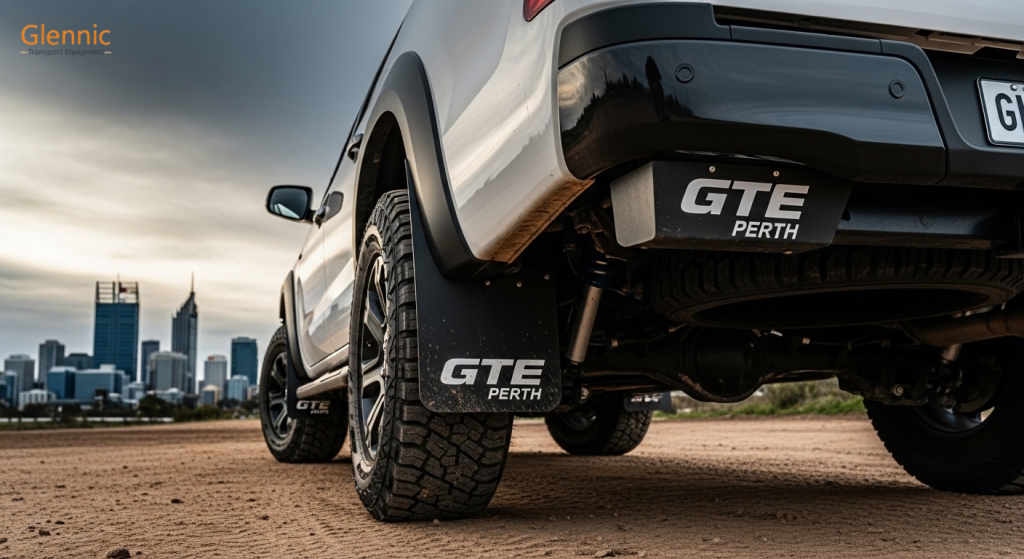
Mudflaps for Utes are essential for reducing dangerous tyre spray, preventing stone damage, protecting your tray and toolbox, and keeping your vehicle compliant with WA mudguard laws. When correctly sized and fitted, they improve road safety, lower maintenance costs, and help you avoid fines or defect notices.
In Western Australia, vehicles must have adequate mudguards or splash suppression to stop debris and water being thrown from tyres. But upgrading tyres, fitting a new tray, or adding a canopy can instantly make factory mudguards non-compliant — leaving your Ute exposed to damage, inspections, and penalties.
So how do you know if your mudflaps are legal, correctly sized, and actually doing their job?
In this guide, you’ll learn why mudflaps matter, what WA regulations require, how to measure them properly, and which type suits your Ute setup best.
Let’s break it down.
What Are Mudflaps?
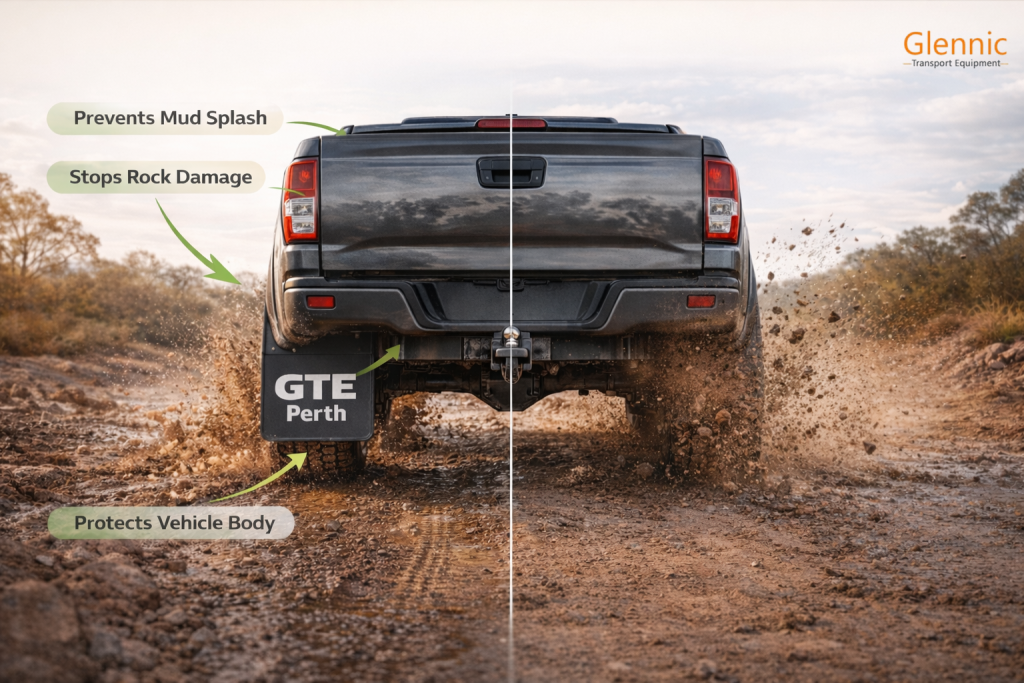
Mudflaps (also called mudguards or splash-guards) are flexible or rigid panels fitted behind a Ute’s wheels to stop water, mud, stones and road debris from being thrown backwards. This improves visibility for following drivers and protect your tray, toolbox and undercarriage.
In simple terms, mudflaps protect both your vehicle and other road users.
Purpose: what mudflaps actually do:
- Reduce spray suppression risk by stopping water from being thrown up by tyres — improving visibility for vehicles behind, especially in wet WA conditions.
- Prevent stone chips and tray damage by catching road grit before it hits your paint, canopy or toolbox.
- Lower corrosion risk by reducing dirt and moisture build-up around sills and steel components.
- Protect trade equipment mounted on trays and underbody areas.
- Help meet WA mudguard and spray-suppression rules when correctly sized and installed.
Function: how do mudflaps actually work?
Mudflaps sit directly behind the tyre’s contact area, stopping debris that would otherwise be flung rearwards at speed. The material absorbs impact energy from small stones and forces them downward instead of allowing them to fly toward vehicles behind you.
When tyres rotate on wet roads, they create a water plume. A properly fitted mudflap breaks up that plume and directs water downward toward the road surface. This significantly reduces spray cloud thickness and improving road safety.
That’s the technical explanation, but the real question for tradies and fleet owners is:
Why do mudflaps actually matter for your Ute, your worksite, and WA compliance?
Let’s break that down next.
7 Reasons You Need Mudflaps for Utes in WA
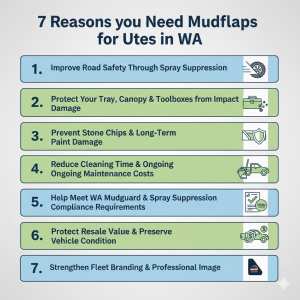
Mudflaps are not just a Ute accessory; they’re a practical safety, protection, and compliance upgrade. Properly fitted mudflaps protect your vehicle, your equipment, and other road users Here are seven practical reasons why mudflaps matter, especially for trades and fleet vehicles.
1. Improve Road Safety Through Spray Suppression
Mudflaps significantly reduce water spray thrown up by tyres, improving visibility for drivers behind you.
When a tyre rotates on wet roads, it creates a plume of water that can temporarily blind following vehicles. Heavy vehicles and Utes without proper spray suppression increase the risk of rear-end collisions during rain. Reducing spray improves reaction time and braking distance for following traffic; especially on highways and high-speed WA roads.
In Perth’s winter months, where sudden rain hits highways like Kwinana Freeway or Tonkin Highway, spray suppression becomes critical.
2. Protect Your Tray, Canopy & Toolboxes from Impact Damage
Mudflaps act as a physical barrier against stones, gravel, and debris that would otherwise damage your steel tray or canopy.
On construction sites and rural roads, loose aggregate is common. Without mudflaps, stones are thrown upward and outward, striking tray side rails, toolbox doors, ladder racks, and canopy panels.
Over time, this causes:
- Paint chips
- Dents
- Surface abrasion
- Seal damage around toolbox doors
Heavy-duty rubber mudflaps absorb impact energy and force debris downward instead of allowing it to ricochet.
3. Prevent Stone Chips & Long-Term Paint Damage
Stone chips are one of the leading causes of premature paint failure on trade vehicles.
Every time paint is chipped, bare steel is exposed. In coastal WA areas; such as Fremantle, Rockingham, or Mandurah, salty air accelerates corrosion.
Mudflaps dramatically reduce the volume of high-velocity debris striking lower body panels and rear quarter sections. This protects rear panels, sills, wheel arches, and underside cross members. Preventing paint damage now avoids costly resprays or rust repairs later.
4. Reduce Cleaning Time & Ongoing Maintenance Costs
Mudflaps reduce dirt build-up, lowering cleaning frequency and long-term maintenance costs. Without mudflaps, road grime spreads across:
- Tray undersides
- Tailgates
- Toolbox hinges
- Electrical fittings
- Tow bar assemblies
This build-up traps moisture and accelerates corrosion, particularly in steel trays.
By directing debris downward instead of outward, mudflaps keep vehicles cleaner between washes and reduce mechanical wear caused by grit infiltration. For fleet operators, even reducing one wash cycle per month per vehicle adds up significantly in labour and water costs.
5. Help Meet WA Mudguard & Spray Suppression Compliance Requirements
Mudflaps help Utes comply with Western Australia’s vehicle standards regarding mudguards and tyre coverage.
Under WA road regulations, vehicles must have adequate mudguards or splash suppression to prevent material being thrown up by tyres. Incorrect tyre coverage or insufficient mudguard drop can result in defect notices, fines, and failed inspections.
When you upgrade tyres, suspension, trays or wheel offsets, factory mudguards often become non-compliant; making properly fitted aftermarket mudflaps essential.
Correct sizing and installation ensure:
- Adequate tyre width coverage
- Proper ground clearance
- Secure mounting
6. Protect Resale Value & Preserve Vehicle Condition
Vehicles with fewer paint chips, dents and rust issues hold stronger resale value. A well-maintained Ute with protected lower panels and tray edges looks more professional and commands higher trade-in value.
Mudflaps are a low-cost preventative upgrade that protects high-impact areas; preserving vehicle condition across years of heavy trade use. Even for sole traders who rotate vehicles every 3–5 years, this protection pays off.
7. Strengthen Fleet Branding & Professional Image
Custom mudflaps can improve brand visibility while maintaining safety compliance. Many WA trade fleets use custom-printed mudflaps displaying company logos, ABNs, and safety messaging. This turns every vehicle into a moving billboard while maintaining spray suppression and tyre coverage.
Additionally, mudflaps can incorporate reflective elements. This improves night visibility and safety perception. For businesses competing in Perth’s trade market, small professional details like fitted, uniform mudflaps reinforce credibility.
Do Mudflaps Affect Fuel Economy?
A common question is whether mudflaps increase aerodynamic drag.
For standard Ute applications, the impact on fuel economy is minimal, particularly when mudflaps are properly sized and positioned close to the tyre profile. The small potential drag difference is outweighed by the long-term benefits of vehicle protection and compliance.
For trade and fleet vehicles, protection and safety far outweigh any negligible aerodynamic impact.
WA Mudguard Rules & Compliance Checklist – 2026 Update
In Western Australia, vehicles must have firmly fitted mudguards or splash-suppression devices; rear mudguards (or fitted mudflaps) must cover tyre width and meet specified height limits; typically, up to 230 mm above ground for most vehicles, or 300 mm for off-road builds.
These rules are set out in the Road Traffic (Vehicle Standards) Rules and related WA regulations. Follow the simple checklist below to quickly confirm compliance.
1. Measure tyre coverage (side-to-side)
Aim for the mudflaps to cover the full width of the tyre (edge-to-edge) or be fitted so that thrown material is contained. If you see the full tyre from behind, the flap may be too narrow.
2. Check vertical drop above ground
With the vehicle on level ground and tyres pointing straight, measure from the ground to the lowest edge of the mudguard/mudflap. For most vehicles the law allows mudguards up to 230 mm above ground. For vehicles built for off-road, use the allowance is 300 mm.
3. Confirm horizontal placement relative to axle
Regulators measure the mudguard edge in relation to the axle and wheel position (rules describe allowable proportions. If in doubt, capture a photo and compare to guidance or ask an installer).
A common rule: the lowest edge should not exceed a specified portion of the horizontal distance to the rearmost axle. Check the official rule text for exact wording.
4. Re-check after tyre, wheel or suspension changes
Fitting larger tyres, different rims or a lift kit can move the tyre arc outside the original mudguard coverage. Always re-measure and re-fit mudflaps after upgrades to keep compliance. Failing to do so is a common source of roadside defect notices.
5. Inspect bracket security & movement
Mudflaps must be firmly fixed and not hang loose. Check mounting brackets, bolts and rivets for tightness and corrosion; replace worn hardware to avoid failures during inspection.
6. Check lighting & reflectors where applicable
If a mudguard obscures lights or reflectors, you may need to adjust lighting position or add reflectors to meet WA visibility rules. The regulations include rules for lights and reflectors. Ensure your mudguard fitment doesn’t interfere.
Which Mudflap Type Is Right for Your Ute & Tray?
Choose mudflaps based on material, drop size, and how the flap integrates with your tray or canopy. For Perth trades, heavy-duty rubber flaps with correct drop usually offer the best blend of durability, spray suppression and compliance; slatted or anti-spray designs suit off-road 4x4s.
Read on to match flap types to your needs.
Heavy-Duty Rubber Mudflaps
Heavy-duty rubber mudflaps (typical drop 200–400 mm) are the go-to for trades. They flex on impact, absorb stone strikes and deliver excellent spray suppression.
Pros: very durable, excellent stone protection and long service life
Cons: heavier and need strong bracket mounting
Best for builders, concreters and fleet Utes with steel trays that face constant site debris.
PVC / Plastic Mudflaps
Plastic or PVC mudflaps (about 150–300 mm drops) are lightweight and budget-friendly, making them common on retail shelves and lighter city Utes.
Pros: cheap and easy to replace
Cons: can become brittle and crack on rough sites or after impacts
Best for light-duty urban use where cost and convenience matter more than heavy stone protection.
Slatted / Anti-Spray Mudflaps
Slatted or anti-spray designs (varied drops, often 120–250 mm) let air pass through to reduce suction and clogging on large tyres, making them popular for touring 4x4s.
Pros: good airflow for big tyres and off-road use, less clogging
Cons: slightly less stone absorption than solid rubber
Best for 4×4 off-roaders, regional operators and anyone running taller tyres.
Custom Printed / Branded Mudflaps
Custom printed mudflaps use the same base materials but add branding and reflective options; drops vary to suit the vehicle and WA rules.
Pros: professional fleet image and added visibility
Cons: higher cost versus unbranded flaps
Best for corporate fleets, service vehicles and businesses wanting consistent, compliant branding across Perth.
Composite / Reinforced Rubber Mudflaps
Composite or reinforced rubber combines tear-resistant fibres with flexible rubber (200–400 mm drops) for heavy-duty use with improved longevity.
Pros: extra tear resistance, excellent for high-impact sites
Cons: premium price
Best for high-mileage fleets and vehicles regularly exposed to sharp aggregate or heavy stone impact.
Mudflap Types Comparison: At a Glance
Type | Typical Drop | Best For | Main Advantage | Watch Out For |
Heavy-Duty Rubber | 200–400 mm | Trade Utes, builders, fleets | Strong stone protection & spray suppression | Needs solid mounting |
PVC / Plastic | 150–300 mm | Light urban use | Affordable & lightweight | Can crack under impact |
Slatted / Anti-Spray | 120–250 mm | 4×4 & off-road | Better airflow for large tyres | Slightly less impact absorption |
Custom Printed | Varies | Fleet branding | Professional image + compliance | Higher cost |
Reinforced Rubber | 200–400 mm | Heavy site exposure | Extra tear resistance | Premium option |
Choosing the Right Mudflap Size & Mounting
To choose the correct mudflap size for your Ute, measure the tyre arc accurately, ensure the flap meets WA height limits, and use a secure mounting system designed for heavy-duty use. Keep in mind:
- Measure the tyre arc correctly: With tyres straight, measure the furthest rearward arc and ensure the flap covers the trajectory.
- Keep within WA vertical limits: don’t exceed the 230 mm / 300 mm thresholds for rear mudguards where applicable.
- Bracket type matters: a solid bracket and backing plate reduce tearing and vibration; under–tray or frame mounting is best for heavy use.
Many manufacturers supply rolls or custom cut sizes. For fleets, consider custom widths and printed branding for uniform appearance and compliance control.
Conclusion: Are Mudflaps Really Worth It?
Mudflaps do much more than stop mud; they improve safety for other road users, reduce stone-chip and corrosion risk, cut cleaning and maintenance time, and help keep your Ute compliant with WA rules. Fitting the right mudflaps is a low-cost, high-impact way to protect your tray, toolboxes and resale value while keeping your team and other drivers safer on Perth roads.
For a compliant, trade-ready solution that pairs perfectly with your tray or canopy, see our Ute trays, integrated canopies and toolboxes, or add practical upgrades while you’re at it.
Ready to stop spray, prevent damage and stay WA-legal?
Get Heavy-Duty Mudflaps Fitted Right by Experts at GTE Perth
We fit compliant, top-quality mudflaps with every tray and canopy install so your Ute is protected and legal from day one. We’ll measure, fit and test for WA compliance, and can supply custom or branded flaps for fleet consistency.
Bundling mudflap fitment with a tray or canopy saves time and ensures everything works together.
FAQs
Are mudflaps mandatory in WA?
Mudflaps themselves aren’t named in every rule, but WA requires vehicles to have adequate mudguards or splash-suppression so that tyres don’t throw stones or excessive spray. Properly fitted mudflaps that cover tyre width and meet vertical drop limits are the usual way to comply.
What is the purpose of mudflaps?
Mudflaps reduce spray and debris thrown by rotating tyres, protect bodywork, trays and toolboxes from stone chips, prevent corrosion by limiting dirt build-up, and help vehicles meet splash-suppression rules; all improving safety and lowering maintenance costs.
Do mudflaps make a difference for 4x4s?
Yes. For 4x4s, anti-spray or slatted designs balance spray suppression and airflow for larger tyres; reinforced rubber flaps are better where stone protection is needed. Choose based on tyre size, off-road use and tray/canopy setup.
Can I fit mudflaps myself?
Yes, many can be DIY-fitted using the correct brackets and instructions. But for tray or canopy installs or when larger tyres/lifts are involved, professional fitting ensures secure mounting, correct clearance, and WA compliance.
Will larger tyres affect the mudflaps?
Yes. Bigger tyres, wider rims or lift kits change the tyre arc. You must re-measure and may need larger or re-positioned mudflaps to remain compliant and protect the tray and body.
How long do mudflaps last?
Lifespan depends on material and use. Heavy-duty rubber typically lasts 3–7 years in trade use. Reinforced composites can last longer. PVC/plastic flaps usually wear out faster (1–3 years) under heavy site use. Regular inspections extend service life.
Are mudflaps good for snow?
Yes. In snow or slush, mudflaps reduce spray and the spread of slush and salt, lowering visibility hazards and limiting salt buildup that causes rust. They’re useful in all wet or snowy conditions.
What is another name for a mud flap?
Mudflaps are also called mudguards or splash-guards. These terms are used interchangeably, depending on region and vehicle type.
Do mudflaps improve fuel efficiency?
Standard mudflaps have a small aerodynamic impact. For most trade Utes it’s negligible. However, fleet operators sometimes use aerodynamic flap designs to capture small fuel savings at scale.