
Ute Tray Tie Down Points: A Guide to Securing Loads Safely
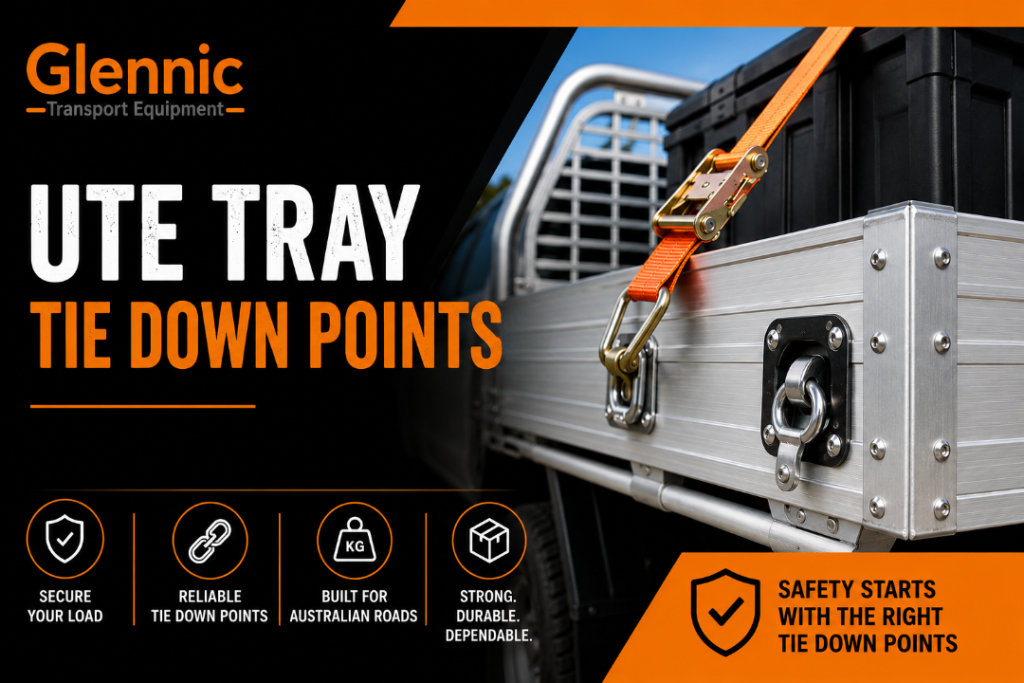
Ute tray tie down points are the rated anchor fittings built into or added onto your tray that give you somewhere solid to attach straps, ropes or chains. Without them, you’re left looping a strap around a headboard or rail that was never designed to take that kind of force, which is where problems start.
Every load puts stress on your restraints each time you brake, corner or hit a pothole. A properly fitted tie-down point spreads that force into the tray’s structure instead of into a weak point that can bend, tear or fail mid-trip. Combined with sensible packing and the right restraint gear, that’s what keeps a load exactly where you put it.
Types of Ute Tray Tie Down Points
Not every tray uses the same hardware, and the type fitted affects how flexible you are with different load shapes.
Floor-Mounted Tie Rings
These are recessed or flush-mounted rings set into the tray floor, usually along the edges. They’re common on both steel and aluminium ute trays because they sit low, stay clear when loading and unloading, and give a direct pull point for straps or ratchet tie-downs.
Rope Rails and Tie Rails
Rope rails, also called tie rails, run along the top edge of the tray sides. Instead of fixed points, Rope rails provide multiple attachment positions along the tray sides, subject to the rail’s design and rated capacity. Aluminium ute tray tie down rails have become popular for this reason: lightweight, corrosion-resistant, and flexible in where you can position a restraint.
Integrated vs Added Tie-Down Points
Integrated points are built into the tray during manufacture. Added or bolt-on points are fitted afterwards, often as an upgrade to an older tray. Neither approach is automatically stronger. What determines strength is the design of the fitting, how it’s constructed, how it’s mounted to the tray, and its rated capacity. A well-engineered bolt-on point can outperform a poorly integrated one, and vice versa.
How to Use Ute Tray Tie Down Points to Secure a Load
Securing a load properly is a sequence. Skip a step, and the rest of your setup can’t fully compensate.
Position the Load Correctly
Position the load so its weight is distributed appropriately within the vehicle’s permitted payload and axle limits, following the vehicle and tray manufacturer’s guidance. Uneven weight distribution puts more strain on your tie-down points and can affect handling under braking.
Choose the Right Restraint
Straps, ropes and chains each suit different loads. The right choice depends on the load’s weight, shape and stability, the restraint method you’re using, and the manufacturer’s specifications for that piece of equipment. Always check the rated capacity before you rely on it.
Attach the Restraint to Suitable Tie-Down points
Use points rated for the load you’re carrying. Restraint performance depends heavily on the lashing configuration, including the number of lashings and the angle they run at. Steeper angles generally transfer more clamping force into the load, so avoid straps that run nearly flat across the top.
Tension and Check the Load
Tension each strap firmly, then walk around and check that nothing is fouling on the tray edges. Check the load and restraints again after starting the journey, and periodically throughout the trip, since straps and ropes can loosen as they settle.
How Many Tie Down Points Does a Ute Tray Need?
The number of tie-down points you need depends on the tray’s design, the types of loads you typically carry, and how you use the vehicle day to day. A tradie hauling long lengths of timber has different needs from someone carrying compact tool boxes.
If you’re ordering a custom tray for your ute, it’s worth discussing your typical loads with the builder so the points can be placed where you’ll actually use them, rather than working to a generic layout.
What Makes a Good Ute Tray Tie Down Point?
A good tie-down point isn’t just about having plenty of them. A handful of well-placed, correctly rated points will outperform a tray covered in weak fittings.
| Quality | What to Look For |
| Suitable rated capacity | A manufacturer-stated working load limit where available, not just a fitting that looks sturdy |
| Secure mounting | Fixed directly into the tray frame, not just the sheeting |
| Practical positioning | Spaced to suit the loads you actually carry, including corners and mid-tray |
| Compatibility with your loads | Matches the hooks, straps or chains you use day to day |
| Ease of use | Accessible without gloves off, awkward reaches or tools |
Ute Tray Load Restraint Requirements in WA
In Western Australia, load restraint is a legal requirement under the Road Traffic (Vehicles) Regulations 2014. Separately, the National Transport Commission publishes the Load Restraint Guide, which sets out best-practice methods for meeting those requirements. The two work together: the regulations establish the legal obligation, while the guide provides the practical detail on how to achieve it.
The core obligation is straightforward. Your load must not be able to move, shift or fall from the vehicle under normal driving conditions, including braking and cornering. According to Main Roads WA, failing to restrain a load correctly can lead to legal action, including a fine of up to $5,000.
It’s also worth checking your ute’s payload capacity alongside your restraint setup. An overloaded tray puts extra strain on every tie-down point, no matter how well each one is rated.
Choosing a Ute Tray With the Right Tie Down Points | Glennic Transport Equipment Perth
GTE Perth designs and fits trays for tradies and 4WD owners across WA, and standard features on our trays include floor-mounted tie rings and rope rails, giving you multiple ways to secure a load straight off the build.
Whether you need extra tie-down points for long or irregular loads, or aluminium ute tray tie-down rails for a lighter setup, our ute trays in Perth are built locally to handle the loads WA tradies and travellers carry every day.
Get a Quote | View Our Ute Trays
FAQs
Anchor Point or Tie-Down Point: Does It Matter What You Call It?
In everyday use, “anchor point” and “tie-down point” mean the same thing to most Australians, and you’ll see both terms used across ute, trailer and truck fitouts.
Can you use factory ute tray tie-down points for load restraint?
Yes, if the manufacturer specifies them for load restraint and their rated capacity suits the load and restraint method.
What is the difference between a ute tray tie-down point and a restraint track?
Tie-down points are individual attachment fittings, while restraint tracks provide multiple attachment positions along the tray for flexible load securing.
How do you secure oversized loads on a ute tray?
Use suitable rated restraint equipment and attachment points, while ensuring the load stays within legal dimensions, weight limits and the vehicle’s permitted overhang.
How do you stop loads from sliding on a ute tray?
Use appropriate tie-down restraint, suitable friction or anti-slip measures, and position the load to minimise movement during braking, cornering and acceleration.
Can you use a cargo net instead of tie-down straps on a ute tray?
Yes, where the cargo net is suitable and rated for the load, but it must adequately prevent movement and comply with load-restraint requirements.